

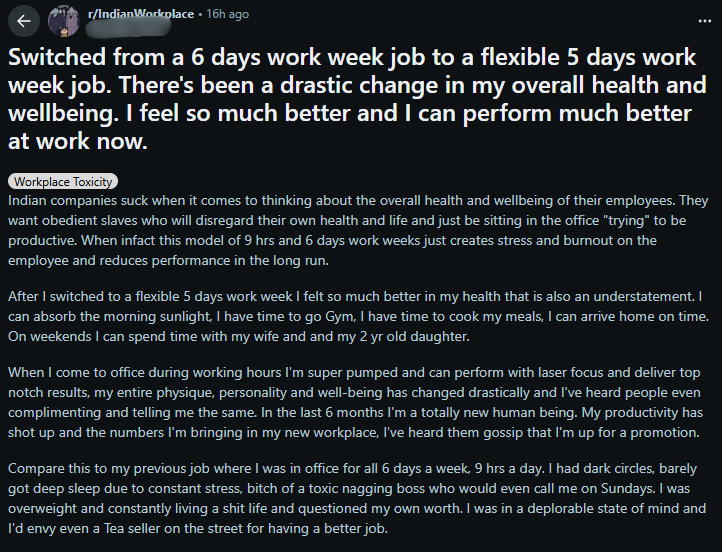
When Infosys co-founder Narayana Murthy suggested that young Indians should work 72 hours a week to help the nation compete globally, he likely did not expect his argument to be dismantled—not by a policy paper or an economist—but by a tired Indian professional on Reddit.Yet that is exactly what happened.A new Reddit post describing the author’s switch from a six-day, nine-hour workweek to a flexible five-day schedule has struck a nerve across India’s working population. Not because it was eloquent or academic, but because it was brutally familiar—and quietly damning of the idea that more hours automatically equal more productivity.
Two visions of productivity, one very tired workforce
Murthy’s argument, made in late 2025, was clear and unapologetic: India needs discipline, sacrifice, and long hours. Drawing inspiration from China’s infamous “9-9-6” work culture—9 a.m. to 9 p.m., six days a week—he argued that work-life balance is a luxury, not a priority, in a country still chasing economic dominance.The subtext was unmistakable: sleep later, relax later, live later.The Reddit post, meanwhile, offers an inconvenient counterpoint. The author describes life under a six-day work regime as a slow collapse—dark circles, poor sleep, weight gain, constant stress, and a boss who believed Sundays were merely a suggestion. Productivity existed, but only in the way a drained battery still shows one bar before dying.Then came the five-day, flexible job—and the plot twist Murthy’s model rarely accounts for.
What happened when the workweek got shorter
Instead of collapsing into laziness, the Redditor reports the opposite. Mornings with sunlight. Time for the gym. Home-cooked meals. Evenings that did not end in exhaustion. Weekends spent with a spouse and a two-year-old child—an activity rarely mentioned in productivity metrics.At work, performance improved. Focus sharpened. Output increased. Numbers went up. So much so that office gossip now includes the word “promotion.”In other words, the worker became exactly what corporate India claims to want: healthier, motivated, and effective. Just not exhausted.
The uncomfortable truth: Long hours often hide bad management
This is where the debate turns awkward.The Reddit post does not argue against hard work. It argues against performative suffering—being seen at the office for nine hours, six days a week, regardless of whether anything meaningful happens in that time.For many employees, long workweeks are not about national growth or discipline. They are about outdated management styles, poor planning, lack of trust, and a belief that exhaustion equals commitment.Murthy’s vision assumes a workforce that can absorb 72 hours of labour without breaking. The Reddit post reflects the reality of a workforce already running on fumes.
Who is this debate really about?
Supporters of the 72-hour workweek argue that previous generations built India’s tech success through sacrifice. Critics counter that burnout, mental health issues, and rising attrition are the real threats to productivity today.What makes the Reddit post resonate is not its language, but its timing. Younger professionals are increasingly questioning why “global competition” always seems to require their health, their family time, and their sleep—while leadership discussions remain comfortably theoretical.
Endurance vs efficiency: India’s real productivity question
The clash between Murthy’s remarks and this viral post exposes a generational fault line in Indian work culture. One side believes progress is earned through endurance. The other believes it comes from efficiency, recovery, and humane systems.The irony is hard to miss. While India debates whether its youth should work 72 hours a week, one exhausted professional quietly proved that cutting hours made him better at his job.Perhaps the real question is not how long Indians should work—but why working less still feels so controversial.
About the Author