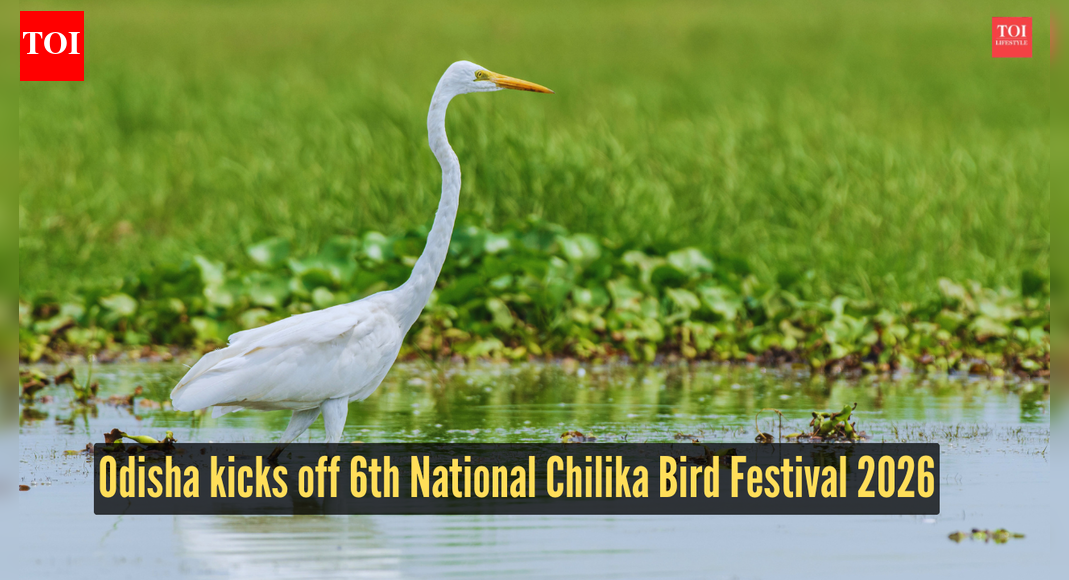
The Department of Tourism, Government of Odisha, in collaboration with the Forest, Environment and Climate Change Department, recently inaugurated the 6th National Chilika Bird Festival 2026 at the State Convention Hall, Lok Seva Bhawan in Bhubaneswar. The festival once again positions Odisha as a national leader in conservation-led tourism, with a strong emphasis on sustainability, community participation, and responsible destination development.The chief guest of the inaugural ceremony was Pravati Parida, Hon’ble Deputy Chief Minister and Minister for Tourism, Women & Child Development and Mission Shakti, Government of Odisha. The function was attended by Hon’ble MLAs, senior officers of the government, environmentalists, ornithologists and travel industry,traders, community leaders and delegates from India and 62 foreign countries.

Addressing the gathering, the deputy chief minister highlighted the ecological as well as cultural significance of Chilika Lake, referred to as Asia’s largest brackish water lagoon and Ramsar wetland of international importance. She pointed out that the National Chilika Bird Festival has emerged as an important avenue for dissemination of conservation, exchange of scientific knowledge and promotion of sustainable tourism practices.Read more: Travel trend 2026: 5 destinations in Asia perfect for slow travel and ‘quietcations’The festival attracts ornithologists, bird photographers, students, researchers and nature lovers and showcases Odisha’s community based conservation model. Mangalajodi’s unique community-led birding initiative, which has become a model globally for conservation success and what local level stewardship can uniquely contribute to biodiversity conservation was highlighted.This year’s show also features improved international engagement, participation of foreign tour operators and birding experts from strategic source markets – Malaysia, Sri Lanka, England, Netherlands and Taiwan. This increasing global acceptance further cements Chilika’s position on the world birding and eco-tourism map, officials said.The 2026 festival has one important highlight to feature, which is the inclusion of Chilika Boat Race, organized by the traditional fishing community of the lake. The project acknowledges and celebrates the living cultural heritage at Chilika and reiterates people as stakeholders for conservational management of fragile wetland eco-system. Festival outreach is supplemented by specific capacity-building and awareness sessions for boatmen and educational programmes for school children from the Chilika region to nurture long-term conservation ambassadors. The first day saw the launch of several publications on conservation, including pocket guides on birds based upon observations of 150 millions birds, a magazine on life and times of flamingos, book on birds conservation in Odissha. Videos on Chilika Lake and satellite telemetry studies of Greater Flamingos were also released. Members of boat associations from Mangalajodi and employees of the Chilika Wildlife Division were also felicitated for their role in conservation.Read more: Which iconic road in the U.S is called the Mother Road; why is 2026 special for this road? State Wildlife Organization, Bhubaneswar under the Forest, Environment and Climate Change Department inked MoU with Indian Institute of Tourism and Travel Management (IITTM). The MoU will support development, marketing and planning of eco-tourism products in the state.On the occasion, Commissioner-cum-Secretary, Tourism Department Shri Balwant Singh briefed about the initiative taken for development of tourism infrastructure and high potentiality towards a prime eco-tourism spot Chilika Lake. PCCF & HoFF Shri Suresh Pant underscored that Chilika plays a stellar role both in the wildlife wealth of Odisha as also sustenance of local livelihoods.As part of the 6th National Chilika Bird Festival, the festivities will also carry on in Chilika – including guided birdwatching at Mangalajodi and Nalabana Bird Sanctuary, expert talks, community-powered cultural exchanges and immersive activities towards biodiversity conservation, heritage preservation combined with sustainable practices.
About the Author