
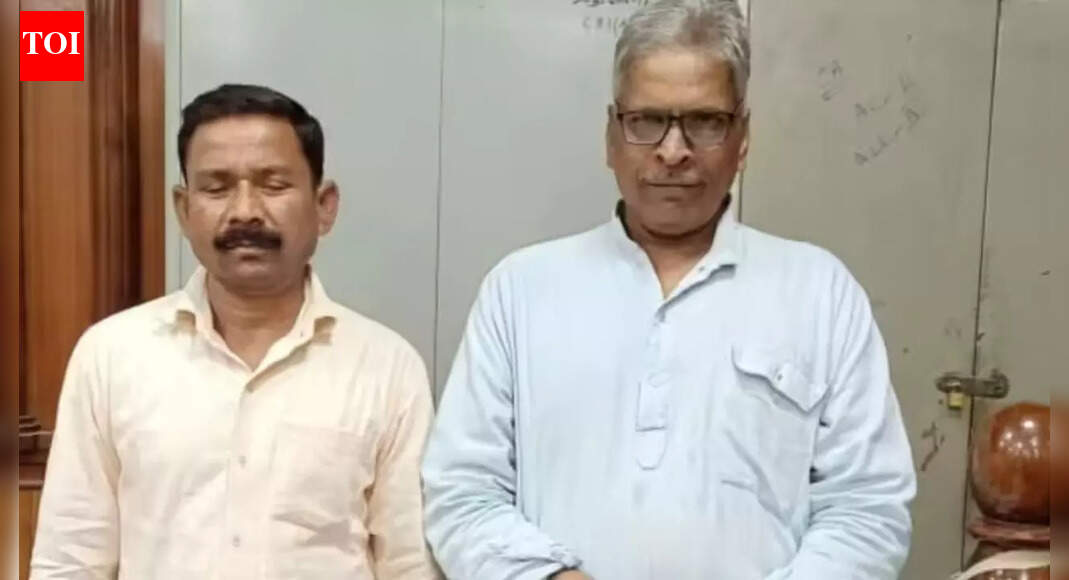

Raja Kolander existed on the fringes of India’s criminal imagination — more myth than man. A self-proclaimed “king” and collector of human skulls, his name evoked terror, whispered even in police files. He left behind a trail of horror: human remains buried in fields, allegations of “cannibalism”, and a man who decided who lived and who died. Obsessed with power, Kolander was accused of targeting victims with chilling precision and allegedly consuming their “brains”, creating one of India’s darkest criminal sagas.But before the skulls, before the journalist’s murder, before the nation recoiled in horror, two young men vanished on a cold January evening in 2000.Their names: Manoj Kumar Singh and Ravi Srivastava.For 25 years, their case drifted through the corridors of India’s criminal justice system — delayed, fragmented, and nearly forgotten. The breakthrough was neither a confession nor a dramatic eyewitness account. It was a simple brown coat, recovered from a village home in Prayagraj, that spoke the loudest. A Lucknow court has finally brought closure to this long, haunting story.
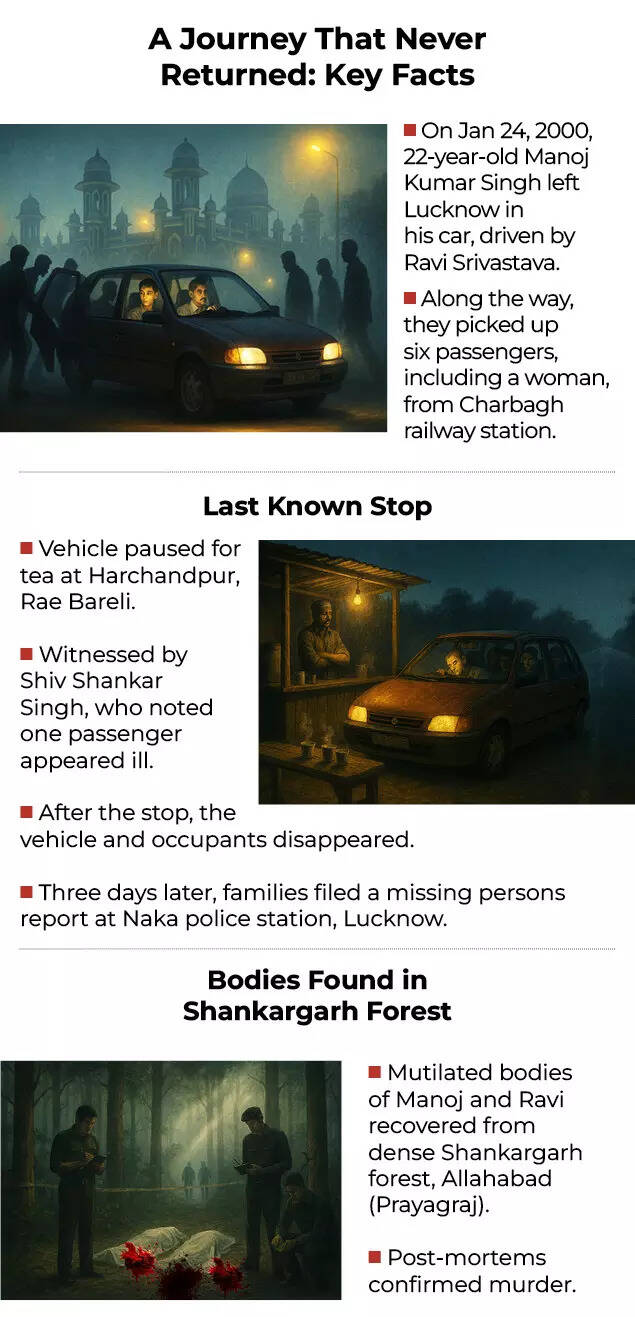
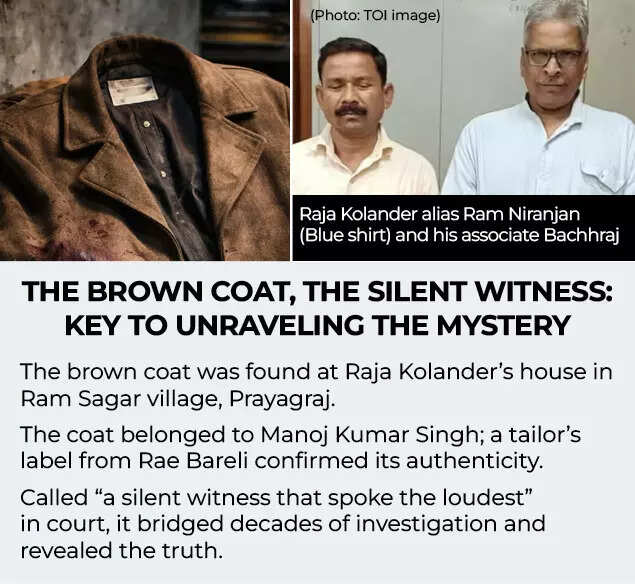
A Journey That Never ReturnedOn January 24, 2000, 22-year-old Manoj Kumar Singh, son of Shiv Harsh Singh, left Lucknow in his car, driven by Ravi Srivastava. Along the way, they picked up six passengers, including a woman, from the bustling Charbagh railway station area. It was an unremarkable decision, a routine choice made by thousands every day.Their last known stop was in Harchandpur, Rae Bareli district, where the vehicle paused for tea. Shiv Harsh Singh’s brother, Shiv Shankar Singh, would later testify in court that he spoke to Manoj and Ravi during this brief halt. Something felt off — one of the passengers appeared ill. That fleeting moment would become the last known sighting of the two men.The vehicle disappeared. So did its occupants.Shankargarh Forest: Where Fear Took FormThree days later, when Manoj and Ravi failed to return, a missing persons report was filed at Naka police station in Lucknow. A search ensued, but the trail had gone cold.The families’ worst fears were soon confirmed. The mutilated bodies of Manoj Kumar Singh and Ravi Srivastava were recovered from the dense Shankargarh forest area in Allahabad (now Prayagraj). Post-mortems confirmed murder. The vehicle was missing. The crime scene yielded almost no clues, and the investigation appeared stalled.The Brown Coat That SpokeThe case, which had remained shrouded in mystery for over two decades, might have continued to baffle investigators if not for one seemingly ordinary item: a brown coat.This unremarkable garment, recovered from the residence of Raja Kolander in Ram Sagar village, Prayagraj, would become the key that finally unlocked the truth. The coat was identified by Shiv Shankar Singh as belonging to Manoj Kumar Singh, the young man who had vanished on that fateful January day. Adding undeniable authenticity, the tailor’s label stitched inside matched a shop in Rae Bareli, confirming that Manoj had been wearing it when he left home.In the courtroom, the prosecution highlighted the coat’s extraordinary significance, describing it as “a silent witness that ultimately spoke the loudest.”Its quiet, unassuming presence had silently preserved the story of that tragic day, bridging the gap between decades of investigative dead ends and the eventual unraveling of a case that had haunted families and authorities alike. What seemed like a simple piece of clothing turned out to be the linchpin in exposing one of India’s darkest criminal sagas.
Witnesses And Courtroom RevelationsTwelve witnesses were examined. Shiv Shankar Singh provided a meticulous account of the victims’ last known movements and the suspicious passengers they had picked up. He testified that Raja Kolander, his wife Phoolan Devi, and others were present in the vehicle and later identified them in court.Amar Nath Singh, another witness, claimed he had seen the accused on the day of the incident and alleged that they confessed during police interrogation.The court concluded that the evidence pointed unmistakably to a premeditated crime involving kidnapping, robbery, and murder.According to the prosecution, the accused abducted Manoj and Ravi, along with their Tata Sumo vehicle, looted them, murdered them cruelly, and dumped their bodies in the forests of Allahabad to prevent identification and destroy evidence.“We examined 12 witnesses, including complainant Shiv Shankar Singh, who provided critical details about the last known movements of the victims and the suspicious passengers. The evidence pointed to a premeditated crime involving kidnapping, robbery, and murder,” said the counsel.Audacity And Horror: Why The Court Showed No MercyThe defence argued for leniency. Raja Kolander, they said, was now aged and had cooperated during the trial. Bachhraj Kol, they argued, had been a juvenile at the time and came from an impoverished background.The court rejected both arguments. The meticulous planning, the cold execution, and the ruthless concealment of the crime outweighed age or circumstance. The offence, committed with clear common intention, displayed audacity and danger that could not be ignored.A Professionally Executed Crime Meets Its VerdictRam Niranjan Kol, alias Raja Kolander, and his accomplice Bachhraj Kol were convicted for the abduction and murder of Manoj Kumar Singh and Ravi Srivastava. Special Judge Rohit Singh described the acts as a “professionally executed and organised criminal conspiracy.”Both convicts were sentenced to life imprisonment and fined Rs 2.5 lakh each. Eighty percent of the fine will be compensated to the victims’ families, with the remainder going to the state government to cover legal costs.The prosecution had sought the death penalty, citing the brutality and convicts’ criminal history. The court declined, ruling that while the crime was heinous, it did not meet the “rarest of rare” criteria.“These are not ordinary individuals,” the judge observed, calling the convicts “undoubtedly dangerous and audacious,” while rejecting pleas for leniency.Legal ChargesRaja Kolander and Bachhraj Kol were found guilty under multiple IPC sections:
- Section 364 (kidnapping with intent to murder)
- Section 396 (dacoity with murder)
- Section 201 (destruction of evidence)
- Section 412 (dishonestly receiving property obtained from dacoity)
- Section 404 (misappropriation of property of the deceased)
All offences were read with Section 34, establishing common intention.Raja Kolander: A Man Who Crowned Himself KingRam Niranjan Kol was not an ordinary accused.A resident of eastern Uttar Pradesh and a member of the Kol tribal community, he was once employed at an ordnance factory. Over time, he withdrew from conventional society and began constructing a private universe governed by power and punishment.He renamed himself Raja Kolander — king of all. His wife was named Phoolan Devi. His sons were called Adalat (court) and Zamanat (bail). Institutions of law were absorbed into his delusion of sovereignty.By the time Manoj and Ravi disappeared, Kolander’s name already carried a sense of menace.A Familiar Name In A Darker CaseBy 2012, Kolander was already infamous. He and his brother-in-law Vakshraj were convicted for the cold-blooded murder of journalist Dhirendra Singh. The victim had been lured, shot, mutilated, and buried.Police recovered 14 human skulls from Kolander’s farmhouse, shocking the nation. Allegations of cannibalism circulated widely, though never proven in court. His reputation as a serial offender and skull collector became ingrained in public consciousness, making him one of India’s most chilling criminals.Collector Of Skulls: Raja Kolander’s Reign Of TerrorRaja Kolander etched his name into the annals of India’s darkest criminal history, horrifying the nation with allegations of cold-blooded murder, cannibalism, and the grotesque collection of human skulls. Obsessed with power, he was said to stalk his victims with terrifying precision, and whispers of him consuming their brains turned him into a figure of nightmares. His crimes were not mere acts of violence—they were a chilling saga of fear, obsession, and horror that haunted communities for decades, marking one of the most sinister chapters in India’s criminal lore.Police investigations revealed a gruesome pattern: Kolander would allegedly kill people over trivial disputes, dismember their bodies, and dispose of the remains in lakes, rivers, or forests. In most cases, he reportedly kept the skulls as trophies, claiming he would “eat the brains” before hanging the heads in his home—a macabre collection that transformed his residence into a chamber of nightmares.What the Case Leaves BehindTwenty-five years after Manoj Kumar Singh and Ravi Srivastava left Lucknow, justice finally arrived — late, scarred, and incomplete, but arrived nonetheless.The Raja Kolander case is a reminder that some crimes are not solved by spectacle or notoriety but by patience, persistence, and evidence. Sometimes the truth does not scream. Sometimes, it whispers from a brown coat, a small detail waiting decades to be heard.And sometimes, evil leaves a trail that, no matter how buried, cannot escape the law forever.
About the Author