
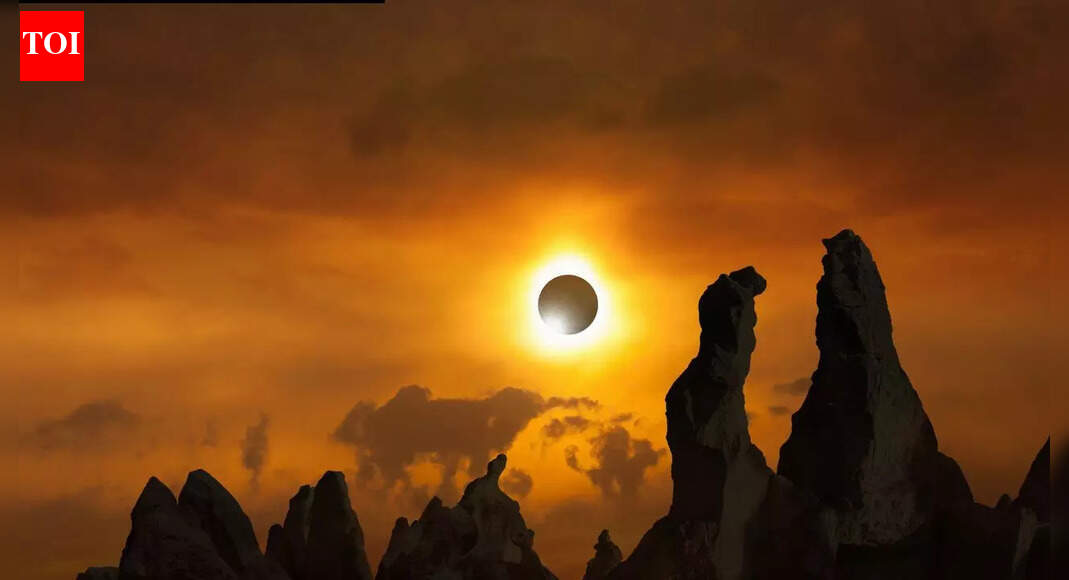
In the year 2026, there will be two incredible solar eclipses that will be visible in the sky. These eclipses will provide astronomers with once-in-a-lifetime opportunities to witness the Moon aligning with the Sun. There will be two types of eclipses: one will be an annular eclipse, which will result in the formation of a bright ring of fire, and the other will be a total solar eclipse, which will be a breathtaking event that will cross several regions of Europe and the Arctic. These occurrences, in addition to being magnificent, provide astronauts with the resources necessary to make studies of the outer atmosphere of the Sun and to monitor changes in the skies above the Earth’s environment.
Solar eclipses of 2026: A full guide including dates, timings, visibility, and safe viewing tips
Solar eclipses in 2026 at a glance
February 17 annular solar eclipse visibility detailsThe initial 2026 solar eclipse is on 17 February, and it will be an annular eclipse. In such a case, the Moon will cover the Sun partially, so one can see a bright ring around its edges. The annularity area will be over East Antarctica.The majority of the inhabited areas are going to see a partial eclipse only. The partial visibility will be available to the residents and visitors of southern Argentina and Chile, the southern parts of Africa, and some adjacent ocean areas. The Sun will not be obscured by the Moon in a way that can be seen in North America during this eclipse.August 12 total solar eclipse path explainedThe biggest eclipse of this year will happen on 12 August 2026. A total solar eclipse will be visible in some areas of Europe and the Arctic regions.The path of totality is Greenland, Iceland, and the northern part of Spain, where the sun will be darkened totally for a brief period.Some parts of Portugal are very close to the route. The majority of Europe, however, will see a partial eclipse. Parts of Canada and the northern United States will also have some sky coverage. The partial phases will be great even if there is no totality in North America.
How to watch a solar eclipse safely
A solar eclipse happens when the Moon is new and a shadow is cast on Earth, so only a few places can see the phenomenon. If the sun is not totally covered, then it is not safe to look at it even for a fraction of a second. Put on a pair of eclipse glasses that meet the ISO standard or a solar viewer that has been approved.For a few seconds, just in the area where the eclipse is total, one can look at the sun without any eye protection. The path of totality, local time, and weather forecasting apps will make it easier for you to plan your trip and have a safe and unforgettable experience.
About the Author