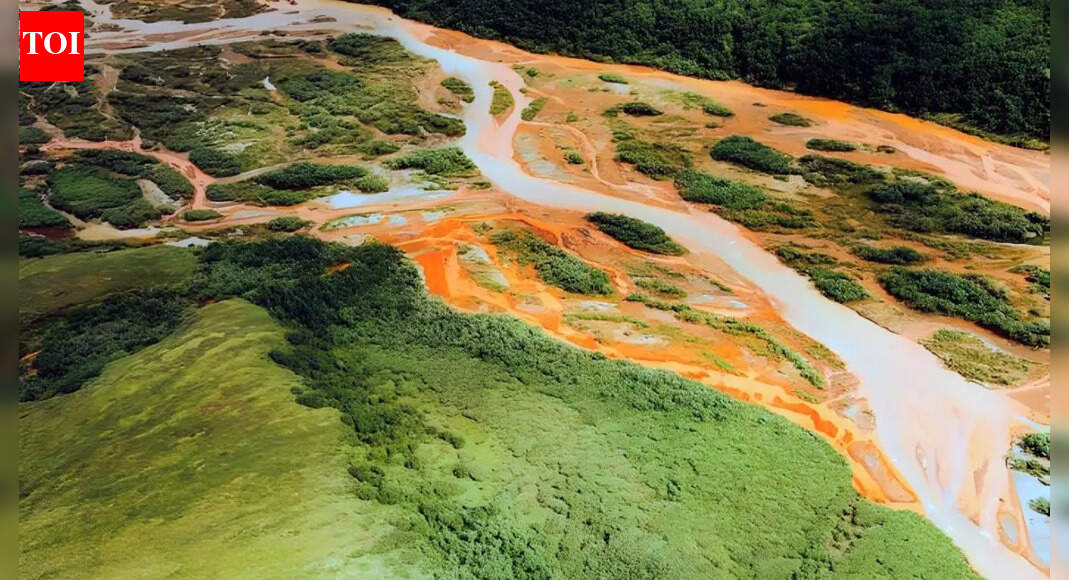
A river in northern Alaska made the scientific community focus on it recently after parts of its waterway had changed their colour dramatically, a fact that led to the establishment that the source was beneath the ground, not just a temporary surface change. The change in colour has been connected to the fact that the levels of metals dissolved in the river system have been increasing, and the process is slowly being detected in various regions of the Arctic. Due to the increase in temperature and the melting of the permafrost, materials that have been frozen under the ground for a long time are being released to the soils and the waterways around the area. This is a challenge to the quality of fresh water, the aquatic ecosystems, and even the people who use the Arctic rivers for food and as a means of cultural continuity. The explanation of why these rivers are turning into different colours is a step towards understanding climate-driven geochemical processes that, in fact, change the polar landscapes.
How melting permafrost is releasing hidden metals into Arctic rivers
Permafrost has been keeping metals like iron, zinc, copper, and nickel within the frozen sediments and for this reason, it can be seen as a natural seal. In northern Alaska, a long period of heating has made the destruction of this wall inevitable, which will thus lead to the exposure of mineral-rich soils to oxygen, water, and microbes. These newly exposed minerals oxidise, and if the iron-bearing compounds do so, they dissolve into the meltwater and groundwater that, ultimately, become rivers. The orange colour that has been detected in the rivers is mostly from the oxidation of iron, which in turn produces rust-coloured particulate matter that is capable of remaining suspended in flowing water.This chemical change also has a great impact on the river’s physical and chemical properties, in that the metals dissolve and the water becomes acidic. Such streams that were once pure now contain more minerals, which change sediment composition along the riverbeds and floodplains. These changes have not been caused by industrial discharge or mining, which, therefore, makes them more difficult to control or reverse. They, however, arise from the warming of soils and the longer thaw seasons, which are diffuse, landscape-scale processes.
How scientists traced rising metal levels in Arctic waterways
The major reason for the detailed explanation of this phenomenon in a recent publication in Nature Communications Earth and Environment was to provide evidence for it having occurred in different Arctic streams, leading to rust-like discolouration. The scientists examined water chemistry, sediment composition, and permafrost conditions in different catchments of Alaska that were affected. The results of their investigation led to the conclusion that metal mobilisation is very fast in thaw-driven exposures of sulphide and iron-rich minerals after oxygen and water enter into previously frozen ground because at that time the minerals react with them.The research illustrated that permafrost degradation can cause these chemical changes even in remote areas that are far from any human infrastructure. In many cases where high levels of iron were detected, other trace metals were found to have increased as well, some of which can be poisonous to aquatic life in high concentrations. Besides that, the study also ascribed these changes directly to permafrost degradation rather than short-term weather events, thereby indicating a permanent alteration of Arctic hydrology. Such changes are reflected in the visible steaming water, which has become discoloured.
What happens to Arctic life when rivers fill with heavy metals
Increasing metal levels in Arctic rivers expose them to various ecological risks. Fish species that have adapted to cold, low-mineral waters may become stressed as acidity and metal content rise. Metals like iron may block fish gills or, if they descend to the sediments, can cover the spawning grounds, making the reproduction areas inaccessible. Invertebrates that constitute the basis of freshwater food webs are extremely vulnerable to changes in water chemistry, which has the effect of the changes being transmitted to the whole ecosystem.The concerns about water quality do not stop at the wildlife. Several Indigenous and rural communities depend on rivers as sources of water for drinking, fishing, and transportation during the seasons. Even if iron is not very toxic on its own, the fact that it is present usually indicates the release of other metals, which, over long exposure, may pose health threats. Water treatment in isolated Arctic areas is at a minimum; hence, natural water chemistry changes become even more significant. Thus, monitoring efforts are becoming more and more significant to determine how speedily and extensively these changes are taking place.
Why warming temperatures are speeding up river changes in the Arctic
The reddish river seen in northern Alaska is an indication of the climate feedbacks that are spreading out all over the Arctic at a fast pace. The melting of permafrost is accompanied by the sinking of the ground, which can cause water to be diverted, forming new channels whereby fresh mineral surfaces are exposed to weathering. Warmer summers and more increased precipitation of rain at the same time continue to enhance metal transport from soils into rivers. Once metals become part of the aquatic systems, through their interaction with organic matter, they can have an impact on the carbon cycle, which, in turn, can influence the quantity of carbon dioxide released into the atmosphere.These developments imply that river discolouration might become a phenomenon that is widespread in the future, as far as Arctic warming is concerned. Researchers are at present using satellite images, on-site sampling, and chemical modelling to be ahead of the game in identifying the catchments that are vulnerable before the changes are physically visible. Though the orange colour can be quite eye-catching, it is only one of the many environmental transitions taking place. The ongoing interplay between thawing permafrost, water chemistry, and ecosystem health will probably result in Arctic freshwater systems being redefined in a way that the changes in colour alone will be surpassed by it.Also Read | Huge underground tunnels found in South America were not made by humans; footprints point to an animal
About the Author