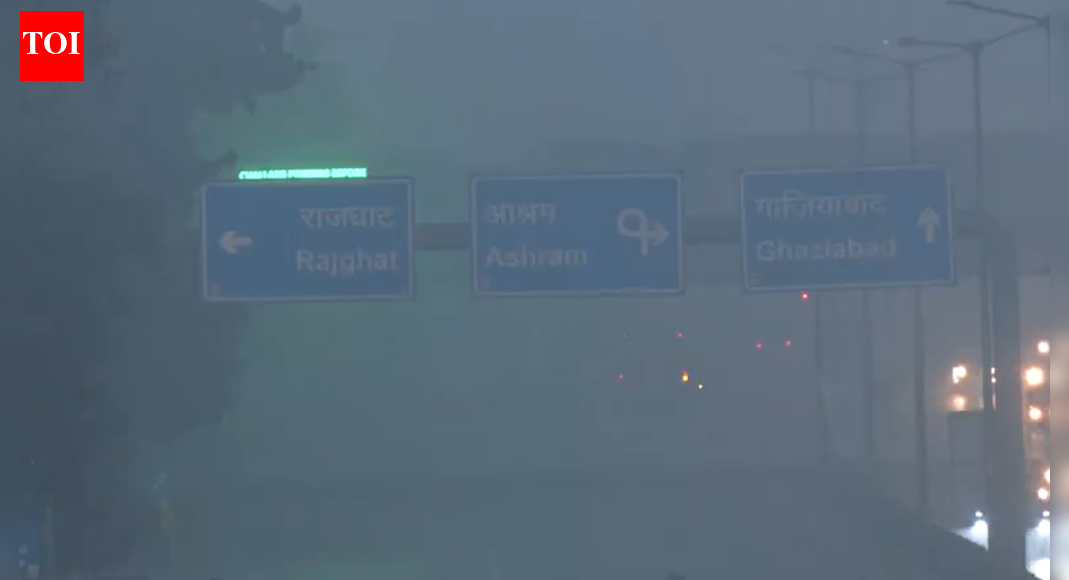
NEW DELHI: The national capital continued to reel under hazardous air conditions on Friday, with Anand Vihar and surrounding areas blanketed by a thick layer of toxic smog.The Commission for Air Quality Management (CAQM) has activated all measures under GRAP Stage-IV in Delhi-NCR to tackle the rising pollution.
According to the Central Pollution Control Board (CPCB), the Air Quality Index (AQI) was recorded at 442 in Ghazipur, 409 in ITO, and 447 in Palam, putting all three areas in the ‘severe’ category. The city’s overall AQI stood at 330 at 7.47 am.Authorities have advised people, especially children, the elderly, and those with respiratory conditions, to limit outdoor exposure as the hazardous air continues to pose health risks.Also read: Delhi air quality worsens: Over 250 flights delayed, 22 cancelled at IGI airport; advisory issued as visibility dropsMeanwhile, the persistent dense fog has also affected aviation operations at Delhi airport. Flight operations are being conducted under CAT III conditions, resulting in delays for several flights.On Thursday, 15 out of 40 monitoring stations recorded ‘severe’ pollution levels in Delhi. Anand Vihar registered the highest reading at 441, falling in the ‘severe-plus’ category, while 24 stations reported ‘very poor’ air quality, according to the Central Pollution Control Board’s (CPCB) SAMEER app. In the morning, the city’s Air Quality Index (AQI) stood at 358.For reference, AQI levels are classified as follows: 0–50 ‘good’, 51–100 ‘satisfactory’, 101–200 ‘moderate’, 201–300 ‘poor’, 301–400 ‘very poor’, and 401–500 ‘severe’.Data from the Decision Support System for Air Quality Management indicates that transport is the largest contributor to Delhi’s pollution, accounting for 18.3 per cent. Industries in the city and surrounding areas contributed 9.2 per cent, followed by residential sources at 4.5 per cent and construction activities at 2.5 per cent. Waste burning contributed 1.6 per cent, road dust 1.3 per cent, other sectors 1.2 per cent, and power generation in Delhi around 1.2 per cent.Pollution from neighbouring NCR districts also added significantly to Delhi’s air quality woes, with Jhajjar contributing 12.3 per cent, Sonipat 8.8 per cent, Rohtak 4.8 per cent, Jind 3.1 per cent, Bhiwani 1.4 per cent, and Gurugram 1.1 per cent.(WIth Agency Inputs)
About the Author