
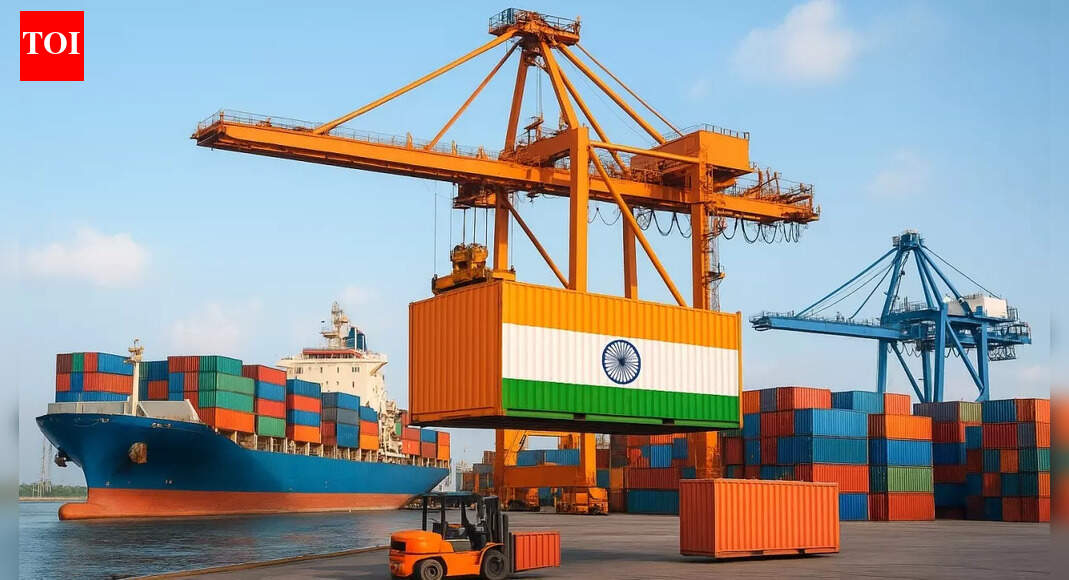
Despite global economic uncertainties, geopolitical disruptions, and softened demand in some markets, India’s merchandise exports continue to demonstrate resilience, the government said on Friday. “There is, as of yet, no conclusive evidence that the export trends are attributable specifically to any tariff-related action. India’s export sectors continue to demonstrate strength and diversification,” MoS for commerce and industry Jitin Prasada told TOI. According to official data by the ministry, India’s total exports for April-October 2025 are estimated at $491.80 billion, marking a growth of 4.84% over the same period last year. Imports during the same period reached $ 569.95 billion, registering a 5.74% increase. Merchandise trade highlights In October 2025, merchandise exports stood at US$ 34.38 billion, down from $38.98 billion in October 2024. Merchandise imports, however, rose to $76.06 billion from $65.21 billion during the same month. For the April-October 2025 period, merchandise exports were valued at $254.25 billion, slightly higher than $252.66 billion in the previous year, while imports reached $451.08 billion, up from $424.06 billion. This resulted in a merchandise trade deficit of $ 196.82 billion, compared with $ 171.40 billion in April-October 2024. Excluding petroleum and gems & jewellery, exports for October 2025 were $28.14 billion, down from $31.32 billion in October 2024. Imports in the same category, including gold, silver, and precious metals, rose to $42.78 billion from $39.58 billion. For the April-October 2025 period, non-petroleum and non-gems & jewellery exports reached $203.40 billion, up from $194.41 billion a year earlier, while imports were valued at $286.28 billion, compared with $264.56 billion previously. Top import sources In terms of month-on-month growth for October 2025, the largest increases in imports came from Switzerland (403.67%), Hong Kong (93.98%), China P Rp (15.63%), the UK (194.41%), and the UAE (14.38%). For the April-October 2025 period, the top sources of import growth included China P Rp (11.88%), the UAE (13.43%), Hong Kong (31.38%), Ireland (169.44%), and the USA (9.73%).
About the Author