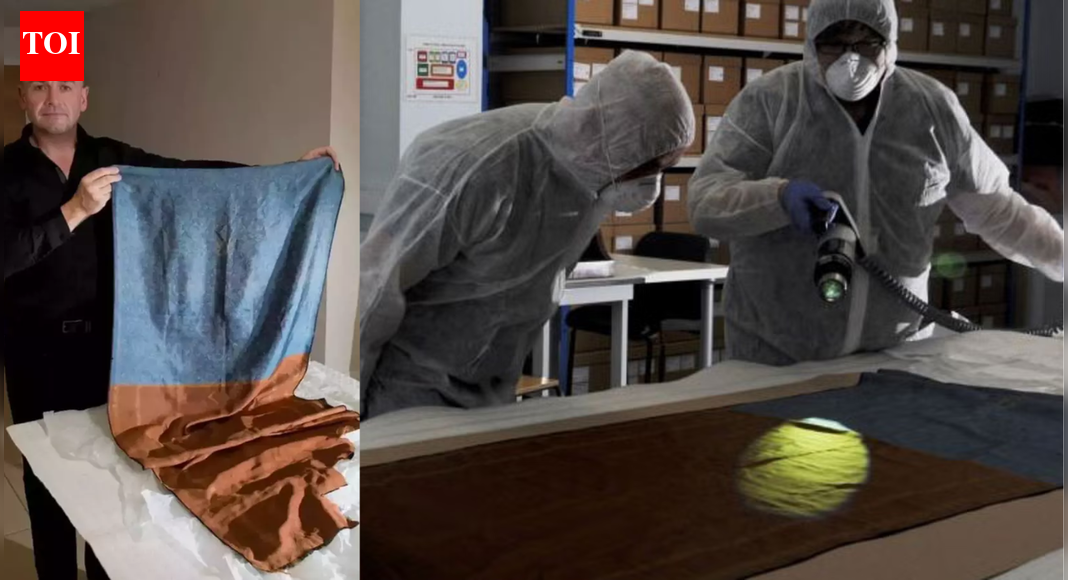
There are very few unsolved mysteries that still grip people the way Jack the Ripper does. In the autumn of 1888, a still-unidentified serial killer stalked the streets of Whitechapel in Victorian London, murdering at least five women, Mary Ann Nichols, Annie Chapman, Elizabeth Stride, Catherine Eddowes and Mary Jane Kelly, a group now known as the “canonical five.” He killed with precision, taunted authorities, and vanished so completely that he became a blank space the world has spent 136 years trying to fill. And because the case left almost no definitive evidence behind, people keep thinking they’ve uncovered the clue that finally cracks it: a new suspect, a forgotten document, a stray bit of DNA on a relic that somehow survived the smog of 1888. This time, the fuss is over a shawl. A London businessman named Russell Edwards says he bought a piece of fabric in 2007, a shawl he believes came from the murder scene of Catherine Eddowes, the Ripper’s fourth canonical victim. According to Metro UK, Edwards claims that DNA traces on it match Eddowes and match a living relative of one of the most famous suspects: Aaron Kosminski, a Polish immigrant and a man Victorian police already suspected at the time. Edwards’ argument is simple: the DNA is on the shawl, therefore Kosminski was Jack the Ripper. But almost every expert who’s looked at the evidence has raised the same eyebrow.
The shawl that started the frenzy, and why experts aren’t buying it
Edwards first published his findings in a 2014 book, Naming Jack the Ripper. When scientists asked to see the technical details behind the DNA analysis, they found… nothing. No hard data, no methodology. As Science.org reported at the time, the claims couldn’t be assessed because the details simply weren’t there. More information finally surfaced in 2019, including a mitochondrial DNA match with a Kosminski relative. But mitochondrial DNA isn’t a fingerprint, it’s a family resemblance shared by thousands of people. As mitochondrial DNA expert Hansi Weissensteiner explained: “One can only exclude a suspect.” Meaning: even if Kosminski could match the sample, so could a vast number of men living in London at the time. It doesn’t pinpoint one individual, it barely narrows the field. The criticism didn’t stop there. Some historians question whether the shawl is even authentic. Others point out that 137 years have passed since the murder, decades in which countless people could have handled, stored, moved, or contaminated the fabric.Forensic DNA interpretation expert Jarrett Ambeau explained on NewsNation that “it doesn’t have the kind of power to identify someone individually… The information just isn’t there in the science to show exactly when the DNA was deposited and by whom.” In other words: whatever story the shawl is telling, it isn’t a definitive one.
Why Kosminski keeps reappearing in Ripper conversations
To be fair, Aaron Kosminski is not a random name pulled from historical dust. He was already one of the police’s prime suspects in 1888. He lived in Whitechapel, struggled with mental illness, and was eventually institutionalised. Several officers wrote privately that they believed he was the Ripper, but the evidence at the time was circumstantial, nothing that could hold up in court then or now. DNA on a questionable shawl hasn’t changed that.
A new book points to a completely different man
Just to show how unsettled the field is: last year, another author said she’d found the real killer, and it wasn’t Kosminski at all. Writer Sarah Bax Horton, whose great-great-grandfather worked on the original case, claims that the Ripper was Hyam Hyams, an epileptic, alcoholic cigar maker living in Whitechapel at the time. In her book One-Armed Jack: Uncovering the Real Jack the Ripper, she argues that witness descriptions line up with Hyams’ medical conditions, including physical impairments she believes match accounts from 1888. She told the Daily Telegraph: “For the first time in history, Jack the Ripper can be identified as Hyam Hyams using distinctive physical characteristics.” That’s the thing about this case , every “solution” reveals how unsolvable it remains.
Will we ever know who he was?
Probably not.The killer is long dead. Every witness is long dead. Much of the physical evidence was never preserved, and what survived is unreliable at best. Even modern DNA techniques can’t resurrect a forensic record that never really existed.Which hasn’t stopped people from trying. Over the decades, Jack the Ripper has been proposed as everything from a violent East End local to a famous French painter, even, in one of the more spectacular leaps, the grandson of Queen Victoria. Part of that is because the case never had a clean narrative to begin with; even the name “Jack the Ripper” came from a letter, likely a hoax, sent to the Central News Agency in September 1888, a bit of Victorian sensationalism that stuck so firmly it became inseparable from the murders themselves.So while it’s entertaining (in a macabre way) to watch new suspects enter the ring, the truth is that Jack the Ripper has become less of a person and more of a story, one that refuses, stubbornly, to close.Edwards believes he has his man. Scientists believe he doesn’t.And somewhere in the gap between Victorian fog and modern speculation, the real answer continues to slip away.
About the Author