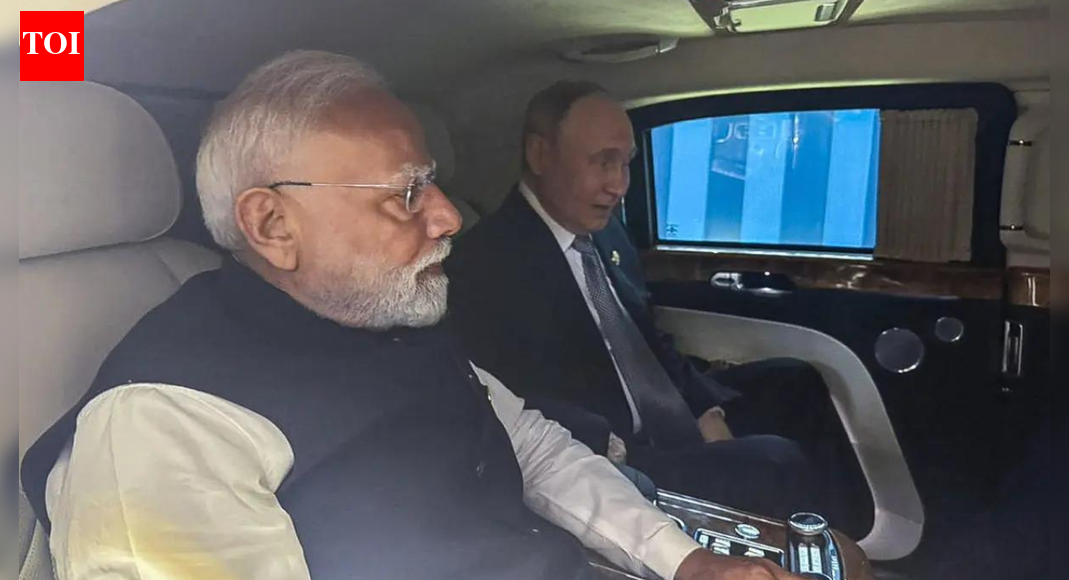
NEW DELHI: Russian President Vladimir Putin lands in India on Thursday for his first visit in four years, kicking off the trip with a private dinner hosted by Prime Minister Narendra Modi. The visit, taking place amid a rapidly evolving global order and ongoing Russia-Ukraine conflict, is expected to put economic cooperation at the centre of talks.
Private dinner diplomacy
Putin’s arrival on Thursday evening will be followed by an intimate dinner with PM Modi. The leaders are expected to review the full spectrum of the special and privileged strategic partnership: defence ties, energy security, trade expansion and cooperation in emerging sectors. They will also exchange views on key global and regional issues, including developments in Eurasia and the Indo-Pacific.
Rajghat tribute , ceremonial welcome & summit
The Russian president’s key engagements are scheduled for Friday. He begins the day with a visit to Rajghat, paying homage to Mahatma Gandhi — a customary stop for visiting heads of state. This will be followed by a formal welcome at Rashtrapati Bhavan, setting the stage for the main summit-level talks at Hyderabad House. The two leaders will meet for wide-ranging discussions aimed at strengthening economic integration, enhancing trade routes, and advancing cooperation in technology, space, logistics and innovation. After a working lunch with PM Modi, Putin will address the India-Russia Business Forum, where both sides hope to energise private-sector partnerships and attract new investments. In the evening, Putin will return to Rashtrapati Bhavan where President Droupadi Murmu will host a state banquet in his honour. He is expected to depart around 9.30pm.
Trade & big-ticket agreements in focus
Putin’s aide confirmed that a joint statement is planned, along with the signing of several bilateral documents spanning multiple sectors. Among them is the Programme for the Development of Strategic Areas of Russian-Indian Economic Cooperation until 2030 — seen as a roadmap to boost long-term trade and industrial collaboration. Ushakov highlighted that the two sides will delve deeply into trade dynamics. Bilateral trade touched $63.6 billion in 2024, marking a 12% increase — driven largely by energy, fertilisers, and machinery. “We have many large-scale promising projects in various areas,” he said, listing industrial cooperation, innovative technologies, peaceful space exploration, transport, mining, healthcare, and labour migration programmes among the priorities. Putin will also participate in the launch event for RT TV’s India operations, signalling Moscow’s intent to expand media and cultural outreach as part of its soft-power strategy. PM Modi and Putin have spoken by phone five times in 2024, and last held an in-person meeting on the sidelines of the SCO Summit in Tianjin. Despite global geopolitical upheavals, the India-Russia relationship continues to adapt, balancing legacy defence ties with new-age cooperation in technology, energy transition, education and workforce mobility.
About the Author