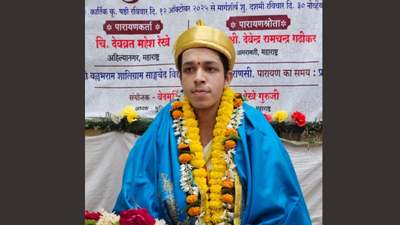
In an age defined by digital noise and dwindling attention spans, the story of a 19-year-old sitting cross-legged in a quiet corner of Kashi, reciting verse after verse with unwavering fidelity, would sound almost anachronistic. Yet it is precisely this devotion to an inherited spiritual discipline that has catapulted Vedamurti Devavrat Mahesh Rekhe into national conversation, and drawn rare, effusive praise from Prime Minister Narendra Modi himself. The Prime Minister’s words, shared publicly as both applause and acknowledgement, have turned the spotlight toward a teenager who has revived a ritual untouched in its classical purity for nearly two centuries.
The rare feat: A tradition revived after nearly 200 years
What makes Devavrat’s accomplishment extraordinary is not merely the rigour of the exercise but its historical weight. According to the Sringeri Math, Devavrat completed the Dandakrama Parayanam in its original classical form, an exacting 50-day recitation of nearly 2,000 mantras from the Shukla Yajurveda’s Madhyandini branch. This discipline, regarded as the “crown jewel” of Vedic chanting for its labyrinthine phonetic architecture, has been recorded only three times in known history.To complete it without a single interruption, not a pause, not a falter, not a wavering breath, demands an ascetic level of internal stillness. The Math’s acknowledgement is, in itself, a historic endorsement: This was not merely a devotional act but a re-enactment of a vanishing art form.
PM Modi applauds the young scholar
Prime Minister Narendra Modi’s response carried the tone of both pride and cultural urgency. Sharing photographs of the young scholar on X, he wrote: “What 19-year-old Vedamurti Devavrat Mahesh Rekhe has done will be remembered by the coming generations!”He continued, emphasising the feat’s magnitude and its rootedness in India’s intellectual tradition: “Every person passionate about Indian culture is proud of him for completing the Dandakrama Parayanam… in 50 days without any interruption. He embodies the finest of our Guru Parampara.”https://x.com/narendramodi/status/1995751533900956129The Prime Minister, also the elected representative from Kashi, added that he was “elated” that such a monumental event unfolded in the sacred city. His tribute doubled as a larger statement about the resilience of India’s oral heritage, upheld this time not by an elder monk but by a teenager with discipline rare even among seasoned practitioners.
Honours and recognition
Recognition from the spiritual community was immediate and generous. With the blessings of the Jagadguru Shankaracharyas of the Dakshinamnaya Sri Sringeri Sharada Peetham, Devavrat was honoured with a golden bracelet worth ₹5 lakh and a cash reward of ₹1,11,116. The gesture underscored the gravity of his accomplishment, a blend of reverence, gratitude, and collective pride.
A teenage scholar and the revival of a vanishing discipline
The Dandakrama Parayanam is not merely a recitation; it is an intense cognitive and spiritual undertaking. Its cadence demands precision that leaves no room for improvisation. Each mantra, each tonal inflection, each breath follows a predetermined map, a discipline that historically required decades of preparation.By executing the Parayanam without pause for 50 days, Devavrat has positioned himself among the rare custodians of a practice once believed to be slipping into ceremonial memory. His achievement is not a modern spectacle but a renaissance of an uncompromising ancient method.
A moment of pride for Kashi, and for India’s spiritual continuum
Kashi, long upheld as a crucible of knowledge and spiritual discipline, now adds a new chapter to its legacy through the accomplishment of a teenager whose name, until recently, circulated only within traditional learning circles. Today, his feat stands as a reminder that India’s intellectual heritage survives not simply in archives or rituals, but in the lived devotion of its youngest practitioners.In Vedamurti Devavrat Mahesh Rekhe, India’s spiritual community finds both continuity and hope, a testament that even in a restless century, the oldest knowledge systems can still find their fiercest champions in the youngest shoulders.
About the Author